Longer summer droughts, rising water costs and watering restrictions make a new approach to garden design essential. A garden planted with well-chosen drought-tolerant plants uses far less water than a traditional lawn-based garden, while offering texture, fragrance and life all year round. The Mediterranean garden is the most attractive expression of this approach and the best suited to our region.
Drawing on our experience at our Bodrum nursery and in our projects on the Aegean coast, we explain how to create a garden that lives on little water.
What Is a Mediterranean Garden?
A Mediterranean garden is a landscape approach using plants adapted to hot, dry summers and mild, wet winters, together with natural stone, gravel and earth-toned materials. Silvery and grey foliage, aromatic shrubs, ornamental grasses swaying in the wind and sculptural olive trees are its characteristic elements. It also aligns directly with the water-saving principles known internationally as “xeriscape”.
Drought-Tolerant Plants
Aromatic Shrubs
- Lavender (Lavandula): With its purple flowers, fragrance and appeal to bees, it is the symbol of the Mediterranean garden. It does best in well-drained, chalky soils.
- Rosemary (Rosmarinus officinalis): Upright and trailing forms are used for borders, slopes and wall tops.
- Sage (Salvia): Many ornamental species flower for a long time and are extremely drought-tolerant.
- Santolina and Teucrium: Low shrubs with silvery, fine-textured leaves, also suitable for formal clipping.
- Myrtle (Myrtus communis): A glossy-leaved, fragrant native maquis species that can also be used as a hedge.
Flowering and Colourful Species
- Oleander (Nerium oleander): Flowers continuously all summer and tolerates drought and salt. As all parts are poisonous, it should be kept away from children’s play areas.
- Bougainvillea: Turns walls and pergolas into a riot of colour in warm coastal climates; frost-sensitive.
- Rockrose (Cistus): With its papery spring flowers, one of the most elegant members of the native maquis.
- Lantana and Callistemon (bottlebrush): Stand out for their long flowering season and heat tolerance.

Ornamental Grasses
Ornamental grasses such as Pennisetum, Stipa tenuissima, Festuca glauca and Miscanthus move in the wind, catch the light and need little maintenance. Combined with lavender and sage, they create a natural, contemporary look.
Succulents and Sculptural Plants
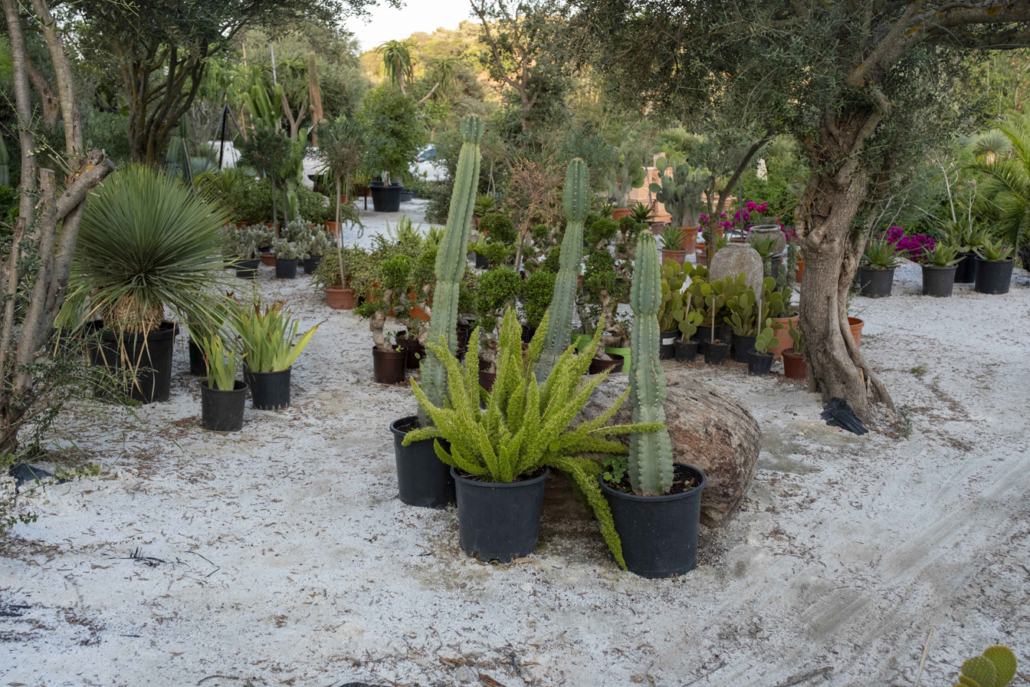
Species such as agave, yucca, Phormium and Dasylirion create a sculptural effect in the garden with their strong silhouettes. Used singly or in groups on gravel, they create a modern dry-garden aesthetic. The monumental element that completes them is often the olive tree; for choosing trees, see our guide to garden trees.
6 Golden Rules for a Low-Water Garden
- Use hydrozoning: Group plants with similar water needs in the same area; keep species that need frequent watering close to the house in a small area.
- Reduce the lawn: Limit lawn to areas that are actually used; turn the rest into gravel, ground cover and shrub beds.
- Use drip irrigation: Drip irrigation and smart irrigation systems deliver water straight to the root zone and minimise evaporation losses.
- Mulch: Gravel, crushed stone or organic mulch retains soil moisture and reduces weeds. For details, see our guide to decorative gravel.
- Ensure drainage: Most Mediterranean plants suffer more from waterlogged roots than from drought. Heavy soils should be improved with sand and gravel.
- Don’t neglect the first year: Even drought-tolerant plants need regular watering until their roots are established, usually for the first 1-2 years.
Choosing Materials for a Mediterranean Garden
Hard materials shape the character of the garden as much as plants do. Local natural stone, dry stone walls, travertine, terracotta pots and timber pergolas complete the Mediterranean aesthetic. With our hardscape and timber works, we turn the planting scheme into a complete composition.
Işık Peyzaj Bodrum Nursery selects and prepares species adapted to the regional climate for each project, providing a long-lasting plant base for villa, hotel and residential projects on the Aegean and Mediterranean coasts.
Frequently Asked Questions
Which garden plants need the least water?
Lavender, rosemary, sage, santolina, oleander, agave, yucca, rockrose and ornamental grasses can survive on very little watering once their roots are established.
Do drought-tolerant plants never need watering?
They need regular watering for the first 1-2 years. Once established, watering can be greatly reduced, but supplementary watering helps during very hot spells.
Can a Mediterranean garden be created in cold regions?
Lavender, rosemary, sage, ornamental grasses and some yuccas are relatively cold-hardy. Bougainvillea, oleander and some succulents should be chosen carefully in areas at risk of frost.
What can be used instead of lawn?
Gravel and crushed stone surfaces, aromatic ground covers (such as creeping thyme), ornamental grass beds and natural stone paving use far less water than lawn.
For a garden that stays vibrant all year with little water, contact our expert team.