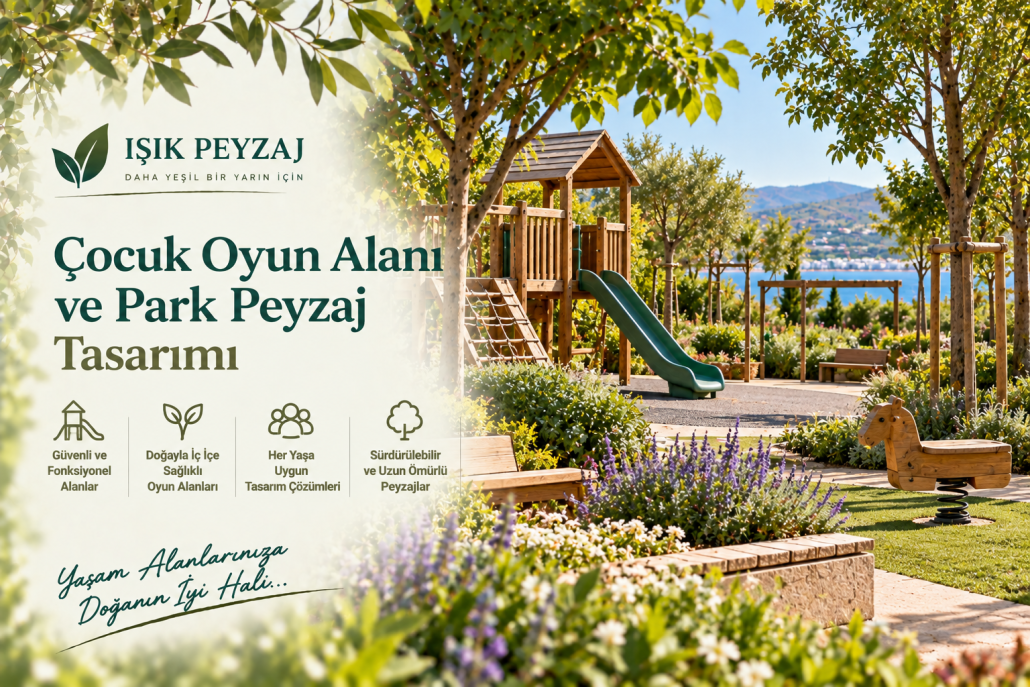
Children’s playgrounds and parks are the most used parts of a landscape project and carry the most responsibility. A well-designed children’s playground doesn’t just look good; it offers a safe, accessible and enjoyable space. In park landscapes, nature, relaxation and play are brought together as a whole that everyone can use. In these areas, safety and function are as much a priority as aesthetics.
In this guide we cover the basic principles of children’s playground and park landscaping, safety and surfacing, planting, shade and comfort elements, and common mistakes. Our Baruthane Ecological Park project gives an idea of the work we deliver at public scale.
Basic Principles of Playground Design
Playground design rests on a few basic principles that make the area both safe and enjoyable.
- Safety: Equipment, surfacing and plants must be safe for children.
- Accessibility: The area should be usable by children of different ages and abilities.
- Visibility: An open layout where parents can easily see their children is preferred.
- Contact with nature: Plants, trees and natural elements help children connect with nature.
When these principles are considered together, the playground becomes a space that is both fun and reassuring.
Safety and Surfacing
Safety is the most critical element of a playground, and surfacing is at its heart. Impact-absorbing surfaces are used under play equipment to reduce injuries from falls. Rubber surfacing, wood chips or special safety surfaces are used for this. Beyond surfacing, leaving enough space between equipment, avoiding sharp corners and choosing durable materials are also fundamental to safety. Hard surfaces and paths are planned in line with our hardscape approach.
Planting and Choosing Safe Plants
In parks and playgrounds, plant choice considers safety as well as beauty. Thorny, poisonous or allergenic species are avoided; instead, plants that are safe for children, durable and easy to maintain are chosen. Shade trees protect from the heat and surround the area with a natural texture. Plant selection and planting are planned according to safety and climate as part of our softscape works.
Shade, Seating and Comfort
Whether a playground or park can be used for long periods depends on comfort elements. Canopies and shade trees make the area liveable in the summer heat. Seating provides comfortable spots where parents can watch their children. Drinking fountains, lighting and signage also make the area easier to use. These elements are planned as a whole, together with seating and signage, as part of landscape furniture.
Design for Different Age Groups
A good playground considers the needs of different age groups together. For young children, low, soft-edged equipment that can be supervised closely is preferred; sandpits and simple climbing elements suit this age. Older children enjoy more active equipment involving climbing, sliding and balance. An ideal design meets these different needs by dividing the area into zones, so younger and older children can play safely without getting in each other’s way. A layout that keeps age groups in mind makes the area both safe and enjoyable for everyone.
Materials and Durability
Playgrounds are constantly exposed to heavy use and the weather, so material choice directly determines safety and lifespan. Stainless metals, UV-resistant plastics and smoothly finished timber are preferred for equipment. Sharp edges, protruding screws and easily broken parts are avoided. Surfacing is equally important; an impact-absorbing, weather-resistant surface provides safety and keeps its form for a long time. Quality materials may increase the initial investment, but they reduce maintenance and replacement costs in the long term.
Maintenance and Longevity
A playground’s safety is maintained not just by installation but by regular maintenance. Equipment joints, the impact absorption of the surfacing and the condition of plants should be checked at regular intervals. A loose screw, worn surface or branch growing over a path can be fixed with a small intervention if spotted in time. Regular maintenance prevents safety risks and keeps the area working as well as on day one for years. A well-designed playground only becomes truly long-lasting with ongoing care.
Common Mistakes in Playground Design
A few common mistakes in playground and park design weaken both safety and usability.
- Neglecting safety surfacing: Equipment installed on hard ground increases the risk of injury.
- Wrong plant choice: Thorny or poisonous species are a danger to children.
- Forgetting shade: A playground without shade becomes unusable in midsummer.
- Ignoring visibility: Enclosed corners that parents cannot see create a safety gap.
Avoiding these mistakes makes the area both safe and long-lasting.
Frequently Asked Questions
Which surface is safest in a children’s playground?
Impact-absorbing surfaces are the safest option. Rubber surfacing, wood chips and special safety surfaces are used under play equipment to reduce injuries from falls.
Which plants should not be used in a playground?
Thorny, poisonous and strongly allergenic species should be avoided. Instead, plants that are safe for children, durable and easy to maintain are preferred.
Why is shade important in park design?
Shade makes the area usable in the summer heat. Canopies and shade trees provide comfort and protect against risks such as heatstroke.
How long does it take to complete a playground design?
The time depends on the size and scope of the area. The process is clearly planned with a work programme drawn up after site analysis and safety requirements.